

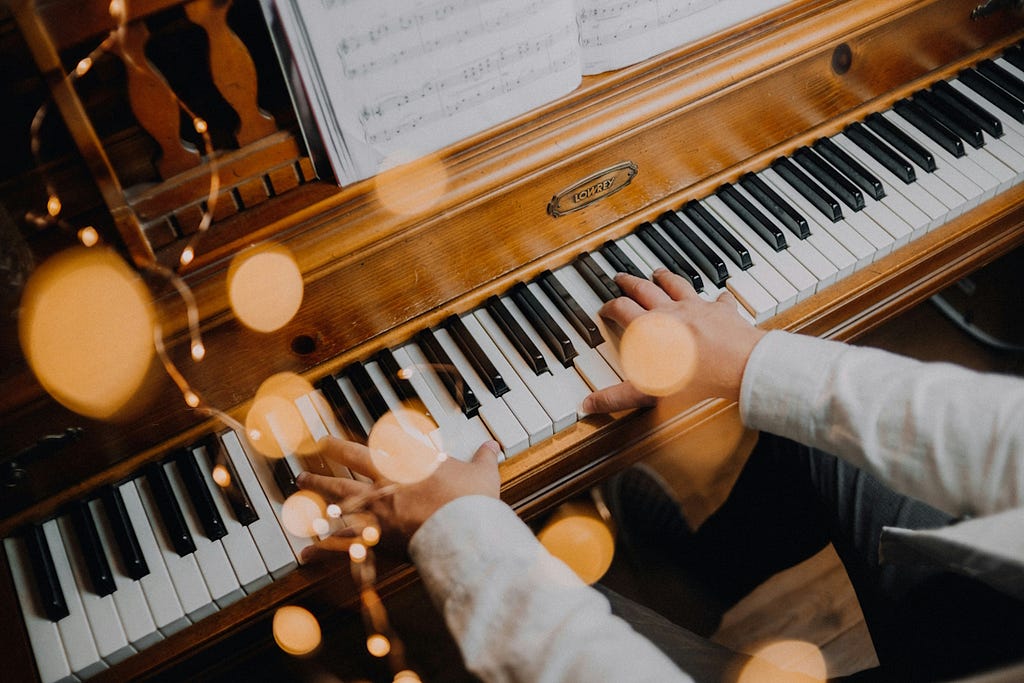
Sergio had practiced a particular jump in Rachmaninoff hundreds of times.
He knew the notes. He knew the fingering. He could execute it — sometimes.
But every time he approached that passage, his body tensed. His focus narrowed to a pinpoint: position on the piano, eyes closed, execute, don’t miss.
“I was so focused on the notes and the synchronization,” he told me, “that I kept it plain, flat — it doesn’t have any dynamics.”
The music sounded mechanical. Because Sergio was treating it mechanically.
He was stuck in what I call the doing mode — the left hemisphere’s worldview where music becomes a thing to be manipulated rather than a being to be honored.
The Doing Mode Trap
When Sergio came to our lesson, he described his practice routine with precision: “I always play from beginning to end, beginning to end. So in the middle, when I make a mistake, I don’t know how to continue.”
He was caught in a cycle familiar to most classically trained musicians:
Execute → Analyze → Correct → Repeat
“I was approaching it mechanically,” he said. “I was trained by my professor from Juilliard — Russian method — just execute. There’s one way to do it, and you have to do it that way.”
The result? Tension after every piece. Rushing through insecure sections. No sense of himself in the music.
“I forgot everything about me,” Sergio realized. “I wasn’t putting anything in — there was no me in the process anymore.”
This is the lie at the heart of mechanical practice: that more effort equals more effectiveness. That if you just analyze harder, control tighter, push faster, you’ll finally get it right.
But the opposite is true.
The Spirit of the Gift
I asked Sergio to try a simple experiment.
“Tap your fingers back and forth,” I said. “First, regard your hands as things to be manipulated. Try to get those fingertips to touch just right, right in the center.”
He did. His face tightened. His movements became rigid.
“Now do the same thing, but regard your hands as beings to be honored.“
The transformation was immediate.
“It’s freer, definitely,” Sergio said. “Before I was so focused — I was like, ‘make sure it’s in the tap, make sure…’ And then when I stopped thinking, it was just… right.”
I pointed out what he might have missed: “Did your fingers go all over the place when you stopped controlling?”
“No!” he said, surprised. “That’s the thing.”
The fingers didn’t fall apart when he stopped micromanaging them. In fact, they moved faster, with better timing, and more sensitive touch.
This is the core insight of what I call the spirit of the gift.
From Manipulation to Relationship
The doing mode — the left hemisphere’s worldview — treats the world as a collection of things to be manipulated.
Your hands: things to position correctly.
That tricky passage: a problem to solve through force.
The music itself: a code to decode and execute.
But the being mode — the right hemisphere’s worldview — sees the world as beings to be honored.
Not objects. Relationships.
When you treat your music as a being with its own spirit, practice becomes an exchange of gifts rather than a transaction.
You make a sacrifice: your attachment to control, your timeline, your concept of “how it’s supposed to sound.”
In return, you receive a gift: access to the music’s aliveness, its beauty, its ability to flow through you.
The Practical Application
We took this to Sergio’s tricky Rachmaninoff passage.
“First,” I said, “play it as a thing to be manipulated.”
He did. Slowly, carefully, mechanically.
“Are you getting tighter or freer?”
“Tighter,” he said. “Even though I’m doing it slow.”
“Is it more fun or less fun?”
“Less fun. I’m just trying to execute.”
I told him what I heard as a listener: “If I were in the audience, I would feel like you’re playing at me. Like you’re angry with the piano.”
Then: “Now treat that same passage as a being to be honored.”
He paused. Played again.
The difference was audible.
“It doesn’t sound how it’s supposed to sound,” Sergio said, “but it didn’t sound robotic.”
Exactly.
The music had to find its way through his own body. It wasn’t perfect — but it was alive.
“Now I was able to put a little bit more dynamics,” he noticed. “It sounded good.”
The Sacrifice Required
I asked Sergio: “When you make a mistake like that, it’s because you didn’t make the proper sacrifice. What do you need to sacrifice to have access to the spirit of this music?”
He thought for a moment. “Maybe… slower?”
“What are you sacrificing when you play slower?”
“Well, I’m sacrificing the tempo. I’m sacrificing how it’s supposed to sound.”
There it is.
You’re attached to a concept — ”how it’s supposed to sound” — and that attachment is blocking your relationship with the music itself.
The spirit of the music can only come through you when you’re willing to let go of your rigid concept of what it should be.
This doesn’t mean abandoning standards or technique. It means practicing from relationship instead of control.
When Sergio played the passage again — slower, receiving it as a being to be honored — the quality shifted immediately.
Not perfect. But present. Musical. Alive.
What Changed
By the end of our session, Sergio had a completely different understanding of what practice could be:
“I will start practicing by phrases instead of beginning to end. A phrase is basically a sentence, a concept — something that has to be all together. I’ve been practicing by measures, or from beginning to end, but that’s not honoring the music.”
He also recognized how this pattern showed up everywhere in his life:
“I was in the doing mode, not in the being mode — not just in piano, but in different ways. I like challenging stuff, so it’s like ‘this piece is not going to defeat me.’ My ego comes into the picture. I power through with willpower. Western culture taught me that — just power through.”
The shift wasn’t about eliminating the doing mode. The doing mode has its place — for figuring things out, encoding technique, solving specific problems.
But the doing mode should serve the being mode, not the other way around.
As I told Sergio: “The doing mode is necessary for getting stuff done, but the being mode is what makes it all worthwhile.”
The Invitation
This week, notice: Are you treating your music as a thing to be manipulated or a being to be honored?
Try the finger-tapping experiment yourself:
- Tap your fingers together as things to manipulate — focus on getting it exactly right
- Notice: tighter or freer? More fun or less fun?
- Now tap your fingers as beings to be honored
- Notice the difference
Then take this to your instrument:
- Choose one tricky passage
- Play it first as a thing to manipulate (execute, control, force)
- Then play it as a being to be honored (receive, listen, allow)
- Notice what shifts
The music has a spirit. It wants to come through you.
But first, you have to stop fighting it.
You have to make the sacrifice: your attachment to control, your timeline, your concept of perfection.
Then the gift comes: aliveness, musicality, freedom.
Not because you forced it.
Because you honored it.
Learn more about the Soulforce Arts Approach at SoulforceArts.com

