

Why “sit up straight” is actually making you tense
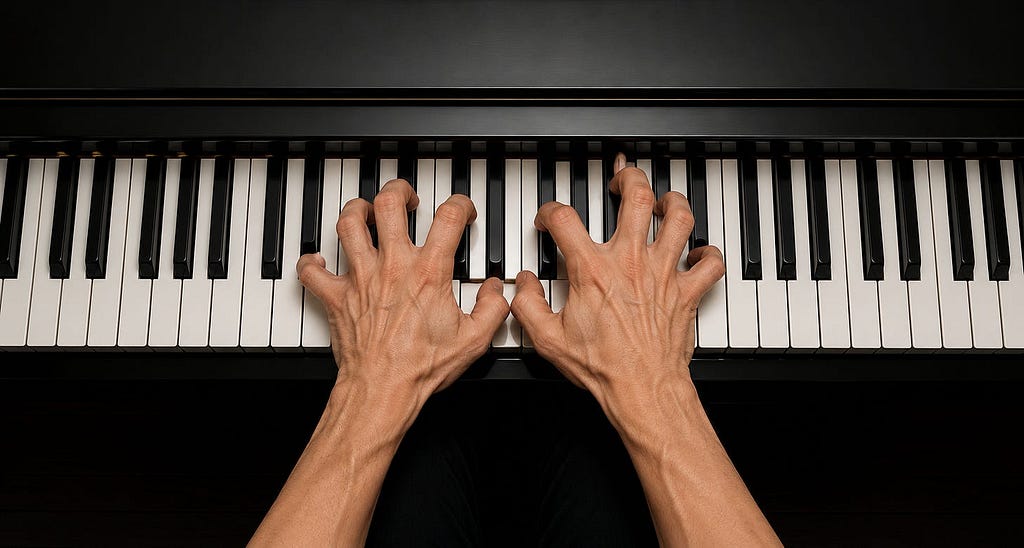
There’s something piano teachers tell every student, usually starting around age seven or eight. They say it with good intentions and genuine concern. And it quietly installs a pattern that will cause trouble for decades.
“Sit up straight.”
Three words. A whole architecture of effort.
I want to tell you about three musicians I’ve worked with recently, because their stories converge on a single point that changed how I think about what’s really going on when someone sits down to play.
The first is a woman I’ll call Stacy. She’s been playing piano for decades — serious, dedicated, technically solid. When she came to me, she described her tension as a knot. Not in one place. Everywhere. A knot that tightened whenever she played and never fully released when she stopped.
We tried the usual approaches first. Awareness exercises. Breathing. Pause techniques. They all helped — she described them as having “loosened the knot.” But the breakthrough came when I noticed something I’d been looking at the whole time without seeing it. Her posture was very upright. She sat at the piano the way you’d pose for a photograph: spine tall, shoulders level, chin lifted slightly. She looked like a pianist. And she was working incredibly hard to maintain it.
I asked her to stop. Not to slouch — just to stop holding. To let her body settle wherever it wanted to go.
The transformation was visible. Her shoulders dropped an inch. Her breathing changed. Her hands, which had been hovering above the keys with a particular controlled precision, softened. She played the same passage she’d been working on and said something I’ve heard variations of from hundreds of musicians: “I had no idea I was working that hard just to sit here.”
The second is a guitarist named Dan. His presenting issue was hand pain — six or seven years of it, severe enough that he’d undergone stem cell treatment. Every specialist he’d seen had examined his hands. Every teacher had focused on his wrist position. The diagnosis was always local: something wrong in the hand, something wrong in the wrist.
What reduced his pain by roughly 95 percent? Relaxing his back.
Not a hand exercise. Not a wrist brace. Not a different guitar position. Just releasing the sustained muscular effort in his back that was traveling down through his shoulders, through his arms, and expressing as tension in his hands. His teachers had been looking at the symptom. The source was three feet north.
The third is a pianist I work with on challenging repertoire — Rachmaninoff, perpetual motion passages, technically demanding music. His tension pattern was what he called “the battle”: a constant fight between the part of him that wanted to rush through difficult sections and the part that knew he needed to slow down. When I asked him what happened right before the hardest passages, he said something revealing: “I brace. Like I’m getting ready for impact.”
The bracing started in his posture. The effort of holding himself upright intensified as the music got harder. By the time his fingers reached the difficult passage, they were operating at the end of a chain that was already locked up from the spine outward.
What these three musicians had in common wasn’t a hand problem, a strength or flexibility problem, or a passage problem. It was a posture problem — but not the kind you’d expect. They didn’t have bad posture. They had too much posture. Too much effort going into maintaining a position that they’d been told was correct, necessary, foundational.
The research is starting to catch up with what I see in the studio. A 2024 study by Wong and colleagues in Musicae Scientiae (https://journals.sagepub.com/doi/full/10.1177/10298649231172928) measured what happens to pianists’ posture after Alexander Technique lessons, using motion capture. AT lessons significantly changed their postural angles — but the direction of change wasn’t toward a “better” fixed position. It was toward less rigidity. Less holding. The pianists didn’t learn to sit correctly. They learned to stop working so hard at sitting.
And a 2025 study in Frontiers in Psychology (Zhang & Li, https://www.frontiersin.org/journals/psychology/articles/10.3389/fpsyg.2025.1601818/full) found that piano students’ musculoskeletal symptoms were associated with both physical postures AND negative emotional states. The finding confirms what F.M. Alexander discovered over a century ago: the effort of trying to sit “correctly” isn’t just physical. When you’re maintaining posture out of obligation or fear of doing it wrong, the emotional dimension amplifies the physical tension. The trying IS the problem.
F.M. Alexander’s most counterintuitive discovery was that people’s attempts to achieve “good posture” — pulling themselves up, holding shoulders back, straightening the spine — were typically the primary source of their tension. The effort of maintaining a fixed position adds a layer of work underneath everything else the body is trying to do. Your hands don’t exist in isolation. They’re the last link in a chain that starts at the spine. If the spine is locked, the hands are compromised before they touch anything.
Alexander called this “end-gaining” — fixating on achieving a specific outcome (correct posture) at the expense of the process (your body’s natural coordination). The irony is beautiful in its cruelty: the harder you try to sit correctly, the more tension you create, which makes your playing harder, which makes you try harder to compensate, which makes you tighten your posture further.
So what replaces the instruction to sit up straight? Nothing. That’s the point.
You don’t need to replace one position with another position. You need to stop adding effort. Your body already knows how to sit at a piano — it’s been organizing itself against gravity for your entire life without you having to think about it. The “posture” you’ve been maintaining is an interference pattern, not a foundation. Remove it, and what emerges is better than anything you could manufacture.
This doesn’t mean you’ll look like a slouch. In my experience, musicians who stop holding themselves up actually look MORE poised, not less — because their bodies find a natural balance instead of a manufactured one. There’s a quality of ease that reads as confidence. Audiences can see it. Other musicians can feel it.
I think about what this means for music education. How many eight-year-olds are sitting down at their first piano lesson right now, being told to sit up straight? How many of them will carry that instruction into adulthood as an unconscious muscular habit — a layer of effort so familiar it becomes invisible, so persistent it becomes permanent?
The good news is that it’s not permanent. Stacy loosened the knot. Dan’s pain dropped by 95 percent. My pianist found his way through the impossible passage by stopping the battle — not between his hands and the keys, but between his body and the bench.
Your hardest passage might not be as hard as your posture is making it.
Here’s what I’d suggest. Before your next practice session, sit at the piano and do nothing for ten seconds. Don’t fix your posture. Don’t adjust your posture. Just sit, and notice what your body is doing. Say to yourself, “I’m at ease with myself and I have plenty of time.” Let yourself be gently aware of the space around you. Think of your head floating in that space. Are you getting tighter or freer? Has letting go of your bracing truly caused you to slump over or are you simply sitting more naturally?
Then play something. Anything. And see what your hands have to say when your back stops shouting.
Want to experience this for yourself?
Get one-on-one coaching for your tension, injuries, performance anxiety, impostor syndrome, or burnout at soulforcearts.com/pwp
Join my free weekly Musician’s Tension Reset Lab: soulforcearts.com/tensionreset
Also, here’s the video I made on this same topic.

